
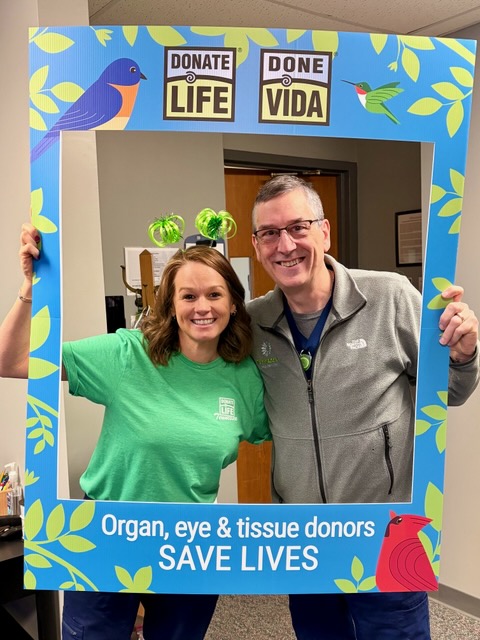
Jim during Donate Life Month 2025
For nearly 15 years, Jim has lived with chronic eye disease.
At 39 years old, during a training in Middle Tennessee, his vision suddenly changed. “All of a sudden, my vision got digitized, it was scary,” he recalled.
Within days, he learned his eye pressure was dangerously high. What followed was a long journey of uncontrolled glaucoma, multiple surgeries and mounting complications.
Over the years, Jim underwent 11 eye surgeries, including cataract procedures and the placement of three drainage devices in each eye. For Jim, doctor visits became routine, sometimes monthly, sometimes multiple times in a week often requiring a two-hour drive to see a specialist.
“It just became something I lived with,” Jim said. “Kind of like a thorn in my side for 15 years.”
Eventually, the strain on his eye led to corneal failure. At first, the symptoms were manageable. But over time, his vision grew cloudy and blurry. Light became painful. Driving at night was difficult. In the final month before transplant, the pain intensified and daily tasks became exhausting.
“I was barely seeing out of my left eye,” he said. “That last month was pretty horrible.”
When his physician recommended a cornea transplant, Jim agreed knowing it would likely not be his last due to the complexity of his case. Still, he was ready for relief and the hope of clear sight again.
Three days before surgery, he received the call that a donor cornea had been identified.
The moment carried deep meaning, not only because Jim was about to receive the gift of sight, but because of the work he does every day.
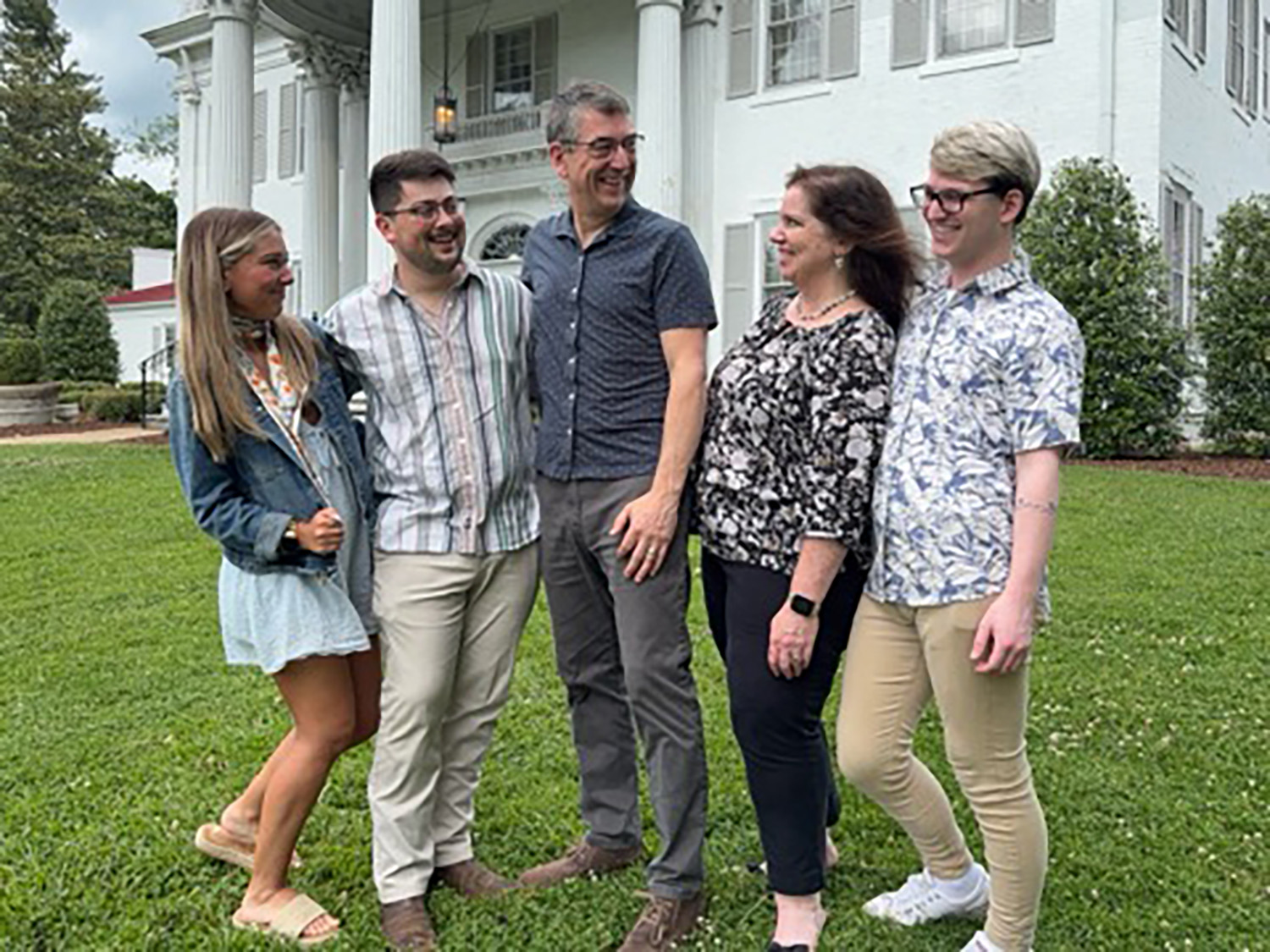
Jim with family
Jim serves as a Family Care Coordinator with Tennessee Donor Services, where he walks alongside families at the time of their loved one’s death, offering the rare and powerful opportunity for organ and tissue donation.
He understands the sacred balance of what he calls “dual advocacy” — caring fully for grieving families while also representing the unseen recipients whose lives hang in the balance.
“In those moments, I’m walking tenderly with a family through profound loss, while holding deep awareness of the recipients whose lives may be forever changed by that moment.”
When he learned a donor had been found for him, his first response was not only gratitude, it was compassion.
“I texted my family and colleagues and said, ‘Please keep the family of my donor in your thoughts. They’re walking through one of the hardest weeks of their lives.”
Cornea transplant surgery is performed while the patient is awake. During the procedure, Jim experienced an unexpected and emotional realization.
“There was this point in surgery,” he shared, pausing, “where I became aware that another person is now part of me.”
That awareness has stayed with him.
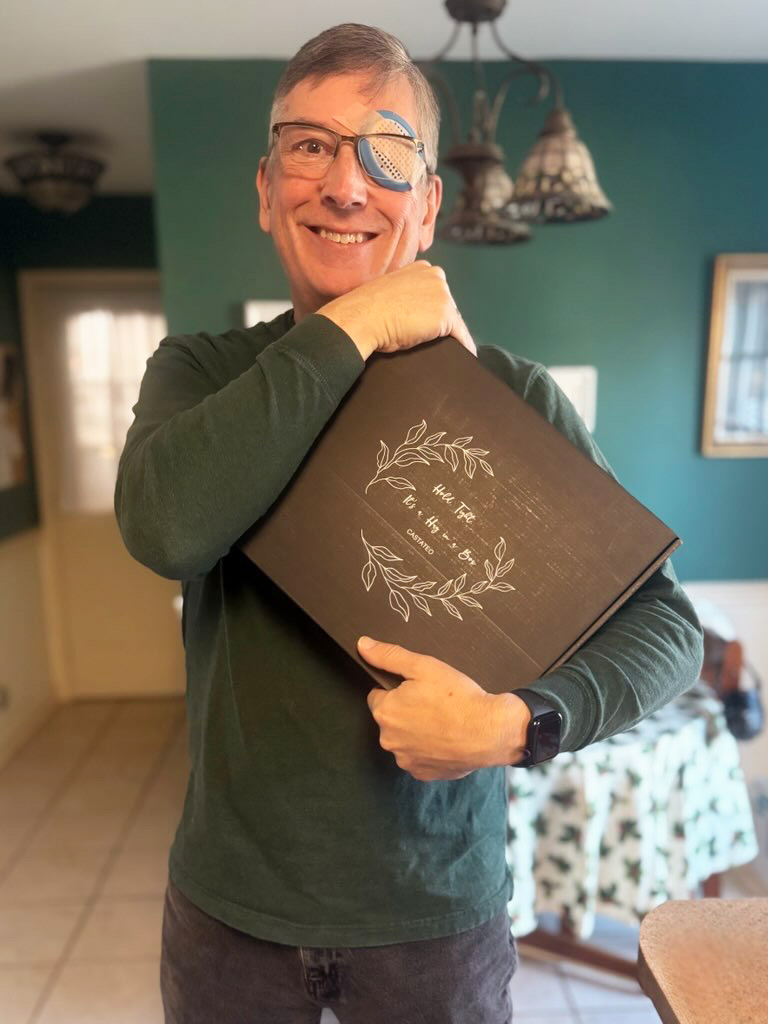
Jim after surgery
After surgery, he learned his donor was a 50-year-old woman from Kansas. Though he does not know her story, he thinks often of her family. Having walked with nearly a hundred families in donation conversations, he understands the weight of that decision.
“Pain doesn’t have to be wasted,” Jim said. “Donation becomes one of those ways meaning is found in the most horrific moments.”
Today, just a few months post-transplant, Jim is no longer living with the constant pain that once defined his days.
“I haven’t been in eye pain since the transplant, where I’d had it for years,” he said. “While my vision’s not 100% yet, but it’s not cloudy anymore. It’s life changing.”
His personal experience has deepened the way he approaches families in his professional role.
“Having needed a transplant myself has deepened the way I hold that balance,” he said. “In those moments, I’m mindful that I’m also carrying the voices of people whose lives may be changed by a donor’s gift.”
Jim hopes his story reminds others that donation is deeply human rooted in compassion, legacy and connection between strangers whose lives become forever intertwined.
“It’s absolutely life-changing,” he said. “Because of the selfless act of another person, either someone who registered or a family who said yes, I can work. I can see clearly. I’m not in pain. That matters.” For Jim, donation is no longer only the work he does. It is the gift he carries every single day.